CALL US NOW

0431 - 2685227

Categories
OUR PROJECTS

Children Project

SEVAI CHILDREN PROJECTS

Children, as `Supremely Important Assets’

SEVAI’s mission is to make a positive change to the lives of disadvantaged children and our vision is a society where each and every child and young person is supported to realise their potential. SEVAI has been helping the children for over 35 years but is still firmly focused on the future – and that means keeping pace with the latest ‘social media’ trends.

SEVAI works as a catalyst to change the lives of under privileged children and give them a better future. Through interventions that engage young children, as well as their parents, caregivers, and communities, SEVAI Children program ensures that young children survive and thrive—that they are physically and emotionally healthy and intellectually curious—and school readiness programs prepare them for school success.

SEVAI Strongly believes that that a few years of life, from conception up to the age of five or six are the most crucial period of human life, when the fastest and most critical developments take place in the human brain and body, and when the foundations of health, intellect, personality and social adjustment are laid.

To enable every individual to grow to his/her full potential and become a healthy, productive and responsible member of society, the child’s basic needs at this stage must be met and failure to do so can lead to permanent and sometimes irreparable damage.

Early Childhood Development is an investment for life. SEVAI committed to meeting the cognitive, social, emotional, and physical needs of most vulnerable young children in the target area. Over the years, SEVAI experienced that Children who participate in early childhood Education, when compared with children who don’t, are more likely to enroll in school, plan their families, become productive adults, and educate their own children. They are less likely to repeat a grade, drop out of school, or engage in criminal activities. The physical, mental, social and emotional needs of the young child can be met through a clean and healthy environment, adequate and appropriate nutrition, and the loving and stimulating care of adult caregivers. The various components of Day care centres/crèche and the services through which are met under this project. SEVAI’s experience in the grass roots reveal that the children of poor women are doubly deprived, by both poverty and enforced neglect by their working parents. Thus, while it is the right of every child to receive the support necessary to reach its full potential, the children of the poor are in special and dire need of such support and in danger if it is not received.

It is clear that the family alone can no longer be expected to fully provide all that is needed for the development of the child, and the State and the larger society have a big role to play in the development of the child.SEVAI team also notices that with the breaking up of joint family system and the increasing number of nuclear families, working women need support in terms of quality, substitute care for Creche and Day Care Services are not only required by working mothers but also women belonging to poor families, who require support and relief for childcare as they struggle to cope with burden of activities, within and outside the home.

Thus SEVAI intervenes in running daycare centre for children/crèches as pilot projects. Under this daycare for children/crèche program, SEVAI ensures that

Reach every child according to age, context, need and relevance, prioritizing the poor, the marginalised and the unreached.

Restructure Daycare centres flexibly, modifying the location, size and timings of centres to reach the unreached, especially women in the unorganized sector. Raise the overall quality of Day-care centres.

SEVAI runs four daycare centres/crèches for 300 infants (0-6 years) in BichandarKoil, MettuMarudur, and Arumbuhalnagar and also inside central women prison of Trichy for the children of the prison inmates’ mothers.

The children are provided with an atmosphere of happiness, love and homely atmosphere.

SEVAI provides sleeping facilities, healthcare, supplementary nutrition, immunisation, for four Day care centres.

These day-care centres have a minimum space of 6-8 square feet per child ensuring their play, rest and learning without any hindrance, with a fan installed in the centre.

These centres have clean toilet and sanitation facility that caters to the needs of small children and also adequate safe play area outside the centre also. Within the centre, there are sleeping facilities for children i.e. mattresses, cradles, cots, pillows and basic infrastructure to meet the requirement of the children. Essential play material and teaching and learning material are also available to meet the needs of pre-school children. Childcare is a basic support to working women and the right of the child.

SEVAI Considers that Day care is an important strategy for poverty prevention and development .

SEVAI provides vital adequate resources for childcare services.

People’s planning and participation are vital to the success of the programmes, SEVAI ensures parents participation.

SEVAI Provides Childcare workers the recognition, adequate remuneration and capacity building.

Language stars Education Project

The Sevai – Language Stars Education Project is born from the collaboration between SEVAI and the Chicago-based language school Language Stars, to provide innovative education methods to children in need in the Tamil Nadu.

In India, mastering the English language is an important, if not necessary, skill: various languages are spoken throughout India and more and more employers demand at least bilingual aptitudes from their applicants. With this observation in mind, SEVAI inaugurated, in 1984, its own English elementary and secondary school, the Sevai Shanti Matriculation School (SSMS).

With the aim of providing innovative and efficient education methods to the children of the SSMS, Language Stars has agreed on a partnership with SEVAI to share its pedagogical know-how. Our belief is that Language Stars’ FunImmersion® method will enable SEVAI children to acquire a natural knowledge of English, thus acquiring solid language foundations they will be able to build upon in their future studies and career.

Language Stars has been providing foreign language education to children in the Chicago area for ten years now through its innovative FunImmersion® method.

The aim of this method is to make the most of children’s unique abilities to absorb a foreign language naturally.

Quality Child-care/ Training given in SEVAI.

A creche worker and helper had undergone a mandatory short-term training.

These trainings have been organised by identified recognised training institutes.

Training is given on areas such as childcare, health-first aid, cardio pulmonary resuscitation, emergency, handling hygiene

Pre-school education has been provided to children in the age group 3-6 years. This is based on early childhood education guidelines.

Proper equipment and learning aids are provided by SEVAI, Develops skills in them for organising various activities to promote all round development of children

Keeps the centre and its surroundings hygienic

  1. Creates awareness about better childcare in the community
  2. Maintains records and register of all beneficiaries
  3. Ensures weekly visits by doctors / health workers and timely first aid.

SEVAI Education Centres provide children with access to quality education, in an interactive and joyful environment.

Ensuring that child rights are met for every child is a daunting challenge for India but also a testimony to the SEVAI’s commitment to the cause of children.

Integrated development of the child is taken care, in the context of family, community and culture. The vital phases of the project are Early Childhood Care and Development, Basic education, Health and sanitation, Capacity building of community based organizations and Livelihood.

Restoration of normalcy in the lives of tsunami affected children and establishing sustainable community based organization to prevent discrimination, violence, abuse and neglect of child.It ensures the rights of children by promoting community groups like children groups, balpanchyat adolescent girls & youth groups and child protection committee. The project implemented in 17 Tsunami affected villages of Nagapattinam District 17 Pre-schools have also been constructed in tsunami affected regions in Karaikal and Nagapatinam.

Child Rights In India, the post-independence era has experienced an explicit expression of the commitment of the government to the cause of children through constitutional provisions, policies, programmes and legislation. In the last decade of this century, dramatic technological developments particularly in the areas of health, nutrition, education and related spheres have opened up new vistas of opportunities for the cause of children. SEVAI had come focusing on the unique problems concerning the children in target area. They include issues related to children and work, tackling the problem of child labour, elimination of discrimination towards Girl Child, uplifting street children, identifying the special needs of children with disabilities, and providing education to every child as its Fundamental Right.

SEVAI simultaneously addresses the needs of young children, women and girls, since mothers are the principal caregivers at this stage. SEVAI provides Education in child protection for Members of SHGs in: The survival, protection, welfare and holistic and total development of the young child (0-6 years) Preparation to enter the primary school (3-5 years) Support as day-care to working women, especially the poor, who need it to fulfill their triple roles as workers, mothers and home-makers and Support to girls, often engaged in care of their younger siblings, to enter school, and complete their education and training.

The first need is for survival, and after conception the girl child is at risk of female foeticide /sex/selective abortion. Hence strict implementation of the laws against sex selection (PNDT Act) as well as widespread awareness campaign on gender equality has been addressed through training to SHGs. During the first two years of life, malnutrition is the greatest threat, and nutrition, health services and immunization are made available to all children, particularly those at risk. SEVAI is committed to empowering children: ensuring survival, supporting children in times of need, protecting children from exploitation, actively promoting children committees and participation. SEVAI seeks to inform and educate the public about the situation of children, women and other vulnerable and oppressed and it acts through local Self Help Groups empowering local people to find their own ways of fighting poverty, illiteracy, injustice and oppression. CARE OF THE CHILDREN/PRESCHOOL EDUCATION INSIDE TRICHY WOMEN PRISON FOR THE INMATES CHILDREN,

CARE OF THE CHILDREN/PRESCHOOL EDUCATION INSIDE TRICHY WOMEN PRISON FOR THE INMATES CHILDREN,

“Crime is the outcome of a diseased mind and jail must have an Environment of hospital for treatment and care” -Mahatma Gandhi

SEVAI aims at reaching the unreached and to resolve social issues by demonstrating right path and right approaches and probably the right circumstances to be created for the convicted women to change and uplift themselves in the society in an acceptable way. With this approach, SEVAI has been carrying out the project, “Day Care Centre for Children since 2003 in Trichy women prison.

SEVAI team ‘’ two counselors and one kindergarten teacher and a vocational educator’ regularly visits women prison inmates and their children in women prison in Trichy. We provide basic essentials for the women and their babies, with teaching and encouragement. Our work with the women led to the prison authorities asking us to develop a day care centre for the children, within the prison grounds. Thirty children are being taken care of at this Prison.

SEVAI conducts one day care centre for the children of the women prisoners who come with their children to the jail with the objective of giving every child the right to survival and development in a healthy and congenial environment, to secure for every child the right to enjoy a happy childhood and to address the root causes that negate the health, growth and development of children. Project provides for life and liberty of all children, promoting high standards of health and nutrition, assuring basic needs and security, play and leisure and all-round development of personality including expression of creativity.

The prison authorities want to care these children in a healthy residential environment. The prisoners are allowed to have their children along with them unto the age of 6 years,SEVAI run Child Care Center in the special prison for women, (central prison, Trichy), provides basic requirements as Trunk box, Mug, Uniform set-2, casual wear-2 sets, school bag, soaps, Bedspread, Bed sheet and a pillow. SEVAI Early childhood teacher is trained with many more choices and decisions regarding the development of their curriculum.

Play way method Teaching & Learning Materials have been used for creating Activity Based Learning for the children.

Children being given individual attention under the Activity Based Learning initiative and are promoted to learn at their own pace, the module is built on the methodology of individual attention and level specific activities tailored to each child.

SEVAI Team works in providing services in the areas of Prison environments to be conducive to the normal growth and development of Day Care Centre Children of Women- Inmates. As many children born in prison have never experienced normal family life up to the age of five years, the socialization pattern of children gets severely affected due to their stay in prison.

They are unaware of the concept of a ‘home’. Boys sometimes talk in the female gender, having grown up only among women in the female ward. Sights like animals on roads frighten these children because of lack of exposure to the outside world. Children get transferred with their mothers from one prison to another. This unsettles them. Such children sometimes display violent and aggressive, or withdrawn behaviour in prison. The Day Care Centre Children of Women- Inmates project studied specific areas with respect to children’s health, education, nutrition, clothing, upbringing, socialization and other related matters, that children of women prisoners who are in jail require additional protection and they also should know what is happening outside the world.

Both mothers and children have provided with facilities inside prison about the world and SEVAI team promoted recreational programs like play materials and recreation materials as the information sharing and they play and remain happy to a maximum possible.

BRIDGE COURSES FOR SCHOOL DROP-OUTS

SEVAI runs bridge courses for Primary school dropouts and those who do not have the privilege to go to school for duration of three to nine months and are being organized for these students to make up for the loss of studies up to class VIII.

The courses start from the academic session. The children, who left the studies after attending primary classes, now are eligible to get admission in the class in which they would have been in the normal course had their studies not been interrupted after completing the bridge course. For instance, if a student left the studies in class IV and wants to resume it after three years, he is will be admitted to class VII and not required to pass classes V and VI and this project is run under SSA guidelines.

The bridge course is was a component of inclusive education for all children up to the age of 14 years. The bridge courses also provide an opportunity to those who have never seen the doors of the school and they would now be able to get admission any class matching their age.

There are at least 250 dropouts in the SEVAI target area was able to get education through formal schooling after completing the bridge course run by SEVAI.

Bridge courses run by SEVAI mainstream the school drop-outs Children

EQUITABLE REHABILITATION OF TSUNAMI VICTIMS PROGRAMME

The children project facilitates the marginalized communities to plan and implement rehabilitation activities for their own development. The project has been implemented within an integrated approach covering various sectors such as education, construction, agriculture, livelihood support and women empowerment; all of them through community involvement. A total number of 12 villages have been selected for the project implementation in Karaikal District covering a total population of more than, 5000 families

Girls Education undertaken in SEVAI:

Integrated development of the child is taken care, in the context of family, community and culture. The vital phases of the project are Early Childhood Care and Development, Basic education, Health and sanitation,

  • Capacity building of community based organizations and Livelihood.
  • Vocational Training, Remedial Coaching, Life Skills Training
  • English Communication skills Development Training
  • SEVAI promotes Parent Partnership and process provides…..
  • Information, support and advice
  • Volunteers to support parents
  • Someone to listen to your concerns
  • There are five core functions of Parent Partnership Services
  • Training and support
  • Networking and collaboration
  • Helping to inform and influence local policy and practice
Categories
OUR PROJECTS

Shelter Constructions

SEVAI Shelter Projects

SEVAI Shelter is not a hand-out but a “hand-up” program.In the village building programme, we select the poor, small and remote villages which are interested in development in all aspects with the help of SEVAI. House construction costs skyrocketed making building construction almost unaffordable to the masses. The energy crisis followed adding to the problem. During later half of 20th Century, there was also greater awareness about the environmental damage due to material manufacturing processes. construction for the homeless and those affected by catastrophe like cyclone, floods since 1976. SEVAI has also participated in the construction of solid house scheme, Samathuvapuram Projects, apart from housing and overseas projects supported by DESWOS, Germany, and Swiss FPV and FdnF. SEVAI has promoted a building material production centre and also construction management and masons training centre in Arumbuhal nagar, Trichy.SEVAI has developed various housing models for schools, farmers market, Police stations, and Police control rooms in Trichy over the years. SEVAI has trained over 600 masons over the years. SEVAI has the capacity of mobilizing the areas of masonry, carpentry, barbendry, house wiring, plumbers and building multi mechanics. The shelter delivery system works through two Building Material Services Banks which are building mate for 5 houses per day. The two main products building cement Blocks and window frames will be locally produced in Poovam in Karaikal. These materials can be chosen because they were both cost planning steps will be implemented to ensure that the end product would really target the design workshop with the village the core houses and secondly, a process will be included a list of the villages, other putting the list reconstruction cross-check. The house takes into environmentally unsound SEVAI has been working in the field of house 500 construction skilled workers a day for masonry in material production centres, producing material cost-efficient and could be produced locally. Two crucial poorest. Firstly, a will be held together communities to design with the beneficiarie step by step screening introduced. This all damaged houses in cross-checking with programmes and to the village committees for a final design of the core consideration speed of ronmentally houses under IAY rial e beneficiaries, to offer appropriate solutions under the community/NGO-based approach able to respond quicker, it was also more targeted and offered less costly solutions for rehabilitation efforts than the slow bureaucratic government set seeking middlemen (builders/masons) used in the government set been replaced by more accessible village construction teams.

Measurements:

  • Standard Method of Measurement of Building Works;
  • Basic documents, specifications, type of clauses, sources of information, specification structure/content, preliminaries specification, typical trade specification, cross referencing and coordination of consultants.
  • Statistics, discount cash flow, probability.

Accounts:

  • Setting up software package accounts, access procedures, basic data entry, rates

    buildups, rates entry and practical application of knowledge to applied measurement. Construction management
  • Construction management, management functions, delegation and authority, motivation, leadership, communications.
  • The property development process constraints, marketing, occupation costs, property management. studies on project management Construction.
  • Project management, procurement methods, design management, builder selection techniques, project planning control techniques, claims and dispute management, negotiation techniques, partnering.

Non-structural elements

  • Non-structural elements in cost environment, suspended ceilings, partitions and cost finishes.
  • Acoustic and lighting fundamentals.
  • Measurement and calculations.
  • Noise control.
  • Integrated thermal, visual and aural design.
  • By-laws and regulations.

Civil Technology

  • Civil engineering technology.
  • The movement of people, communication and Organization systems.
  • Maintenance of buildings.
  • Facilities management.

production and construction, ease of transportation of building elements and ease of construction by local village masons, besides incorporating structural aspects of tsunami resistance. The design and detailing process will be a continuously evolving one with input and feedback from users and implementers being incorporated into the design and new details will be Community and NGO-based shelter delivery systems

The approach outlined here will have an extremely tight time schedule. Not only was set-up. Another obvious advantage is that the opportunity set-up has effectively thod ion – site selection, market research, finance, Interactive

  • The general economic theory, the price mechanism, supply and demand analysis, firms and industries, economic systems.
  • Labour, wages and employment. The employment scene in rural areas was grim and that was followed by heavy migration to urban areas which caused numerous civic and social problems. From the moment SEVAI Started its housing project way back in 1977, SEVAI has been involved with homes of many dimensions and categories. And around the late ’70s we got involved with mass housing for flood and cyclone victims. The designs were well-detailed; we understood that Government can only act at best as catalysts. Over last two decades, considerable work has been done in the field of alternative construction technologies. The knowledge and the experience gained have the potential to impact the construction scenario in the country. But, unfortunately, the knowledge dissemination has been largely inadequate. The human resource development in the field is also limited. The end users also are not adequately aware of the alternatives that are available. Hence, there is an urgent need to reach out to various stakeholders and potential change makers. SEVAI works in partnership with local, grass root community based Organizations such as Self Help Groups, Panchayat Level Federations to reach people in need of decent housing. The cost of construction is equally borne by three stakeholders i.e. Beneficiary, Local Government and SEVAI. Before we select a village, we explain the conditions to the villagers, and put them to tests and their participation in the programme is assessed. It is along process of learning for the villagers, including youth and women. The villagers submit an application to SEVAI requesting to develop their village and are interested to learn village development activities.

Every week the village representatives attend the meetings and learn the programme. They also visit the old villages which, were built by SEVAI to see and to meet villagers as to how they worked hard and developed their village. The testing process takes a few months. Meanwhile, we prepare a detailed project proposal and send it to the sponsors abroad. The common site also will be cleared and made into one plot, fix the village boundaries, prepare a systematic layout with clear roads, common plots, house plots, etc,. We also explain the conditions during the construction programme and make the villagers understand it. The village council is also trained in that period. After the process is over we lay the village foundation stone with the visitors, if any or with the local govt. officials. Then the villagers start making roads, dig drains as per the new village layout, also start preparations for tree plantation. If there is not much water facility in the village, we drill a bore well or two for starting the programme. Meanwhile, we collect the details of materials availability, take quotations and arrange materials for starting the work. During construction, one person from each family should work in the village. The beneficiaries do not know where their house is, we build the village in a learning aspect. The youth from the village should learn construction skills like carpentry, rod bending, centering, masonry, etc., during the construction.

SEVAI Cost Effective Housing is a re seeks to reduce the cost construction through better management, appropriate use of local materials, skills and technology but without sacrificing the performance and life of the structure. It needs to be emphasized that low cost housing does not mean houses constructed by utilizing cheap building materials of substandard quality. A low cost house is designed and constructed as any other house with regard to foundation, structure, strength etc. the reduction in cost is achieved through effective utilization of locally available building materials and techniques that are durable, economical, accepted by users and not requiring costly maintenance, Economy is also achieved by postponing finishing and/simple them in phases. Further, it aims at increasing the efficiency of workers, minimizing wastage in design and space and applying good management practices, so that shelter can be provided at prices which people can and write their names and small words. During the construction time we take the attendance of the beneficiaries for the days they present in the work. After completion of the village, basing on the presence in the work, we allot the ho prepare a detailed file for the process of village building programme and fix a date to inaugurate the village with the presence of the sponsors or by the local government officials.The people during inauguration; the village part in maintenance and improvement of the village in all aspects.

SEVAI Principle applied to CONSTRUCTION:

SEVAI Construction to be truly Village building

  1. should provide security
  2. should be linked to learning
  3. should be community work
  4. should reveal newness
  5. should fit in with the natural environment
  6. should offer better future work opportunity
  7. should have equally sharable results.

SEVAI PERSPECTIVES OF CONSTRUCTION

  1. Architecture is the best and perfect science because it needs all other sciences like Physical science, Environmental science, Social science, Climatology, Geology and so on. And building is learning. Architecture is also a safety/security factor. For instance, after a cyclone we build houses for safety. So also, a house is a safety measure against fire. A house is an asset, too.
  2. A house is a factor of dignity. A person is judged in accordance with the house he or she owns. The One can always make improvement
  3. A house also gives a sense of freedom. The owner of a house feels that he/she is not relative concept and has more to do with budgeting and it unction afford. The adults in the village should be able to read houses for the beneficiaries. We villagers make an oath saying that they take ould ance, improvement on it. a beggar, is not on the streets.
  4. We build a house normally for a family. Livelihood and Housing:

The focus on the role of sustainable habitat technologies and their contribution to livelihood creation in various contexts of social housing programs, reconstruction in post disaster situations and setting up supply of affordable technologies while catalyzing demand in the lative implementing ould uses rs zing markets of the rural poor. A typical example in case is the initiative of SEVAI, a nongovernment Agency in association with Econ Industries – a sister private sector company. SEVAI (Society for Education, Village Action and Improvement) is a voluntary service organization working for the integrated development of the rural poor in the villages and slums of Trichirapalli, coastal Nagapptinam, Karaikal and Pondichery through empowerment of the rural poor and active involvement of target community in all phases of program like planning, decision making, implementation and evaluation. One of SEVAI’s significant achievements has been the consolidation of women’s self-help groups for saving and group enterprise activities. More than 6000 SHGs now operate under the SEVAI umbrella. Econ Industries produces and sells building materials and provide skills for housing and other building activities in the region. SEVAI set up a revolving fund to finance the housing needs of its members. Loans, which are available at a small rate of interest, are linked to the products and services available from Econ. Econ on its part is committed to the production of ‘Energy Efficient Cost Effective Materials’. With a 100% recovery rate, the SEVAI – Econ partnership is set to demonstrate a viable and profitable approach to habitat upgradation of the poor.

SEVAI recognizes the need to provide shelter at the times of disasters.

Devastating natural disasters happen often. Families left homeless by disasters face uncertain futures; often confronting dire housing needs as they struggle to rebuild their lives. SEVAI recognizes the need to provide shelter and housing solutions to help these families recover. SEVAI Disaster Response program works with the community in the areas of disaster mitigation, preparedness, shelter and long-term recovery initiatives to address the housing needs that arise from natural disasters and humanitarian emergency conflicts. The mission of Disaster Response is to develop innovative housing and shelter assistance models that generate sustainable interventions for people vulnerable to or affected by disasters. Disaster Response also builds the capacity of the community in the areas of disaster mitigation, preparedness and recovery through education, training and partnerships.SEVAI understands that supporting families affected by disasters and conflicts requires immediate, comprehensive and collaborative actions. SEVAI recognizes the need to develop long-term shelter and housing solutions for disaster-affected families and to help communities protect themselves against future threats in disaster-prone areas.

Reconstruction of 1280 permanent Houses for tsunami victims.

The Tsunami of December 26, 2005 wreaked havoc on the coastlines of several countries. It caused serious loss of lives and livelihoods to the coastal communities of India. The Tsunami inflicted irrecoverable damages on human lives. In India alone, 10,672 lives had been lost and 5,711 persons were listed as missing. 647,000 persons had lost their homes/household assets and had been relocated into temporary shelters. Building was not considered separate from designing, rather an evolving relationship through the construction process. It was hence, seen as essential, that the design team is locally situated and that the building process is not handed over to any big builder who would enforce centralized decisions. Instead, labour teams were recruited and trained in quality construction work. The teams of house owners, cluster committee members, volunteers and modern master craftspersons (architect-engineer-community development officer) worked in tandem, making micro-level changes as they went along within a broader macro framework of quality construction.

A distinctive feature of SEVAI housing policy has been the model houses that it has constructed in real dimensions to give a range of options to house owners in keeping with their needs and aspirations for their future dwelling. This was very well received by the community and led to a participatory approach towards housing wherein the community members knew from the outset about the house which belonged to them and in turn induced their participation right from customisation of design, to engaging with masons, contributing to the curing and discussing the progress of their houses and concerns in weekly and monthly meetings with SEVAI. The community participation and ownership stands amply vindicated by the house occupancy rate and the post occupancy feedback provided by the house owners. It is not only the volume and scale of the SEVAI reconstruction project that makes it ambitious but also people’s participation being attempted on an unprecedented scale in such a housing project. In fact, the idea has been to go beyond mere participation and to actually make it a people owned and managed process. SEVAI played a crucial role in making available information and analyses that could help the people make the best choices. As a result the project ensured strong anchorage of technological and managerial decisions on community input derived through sustained consultation around issues such as settlement location and planning, desirable common facilities and spaces, house designs and technology choices. The realization of these principles crucially hinged on appropriate capacity building initiatives targeted at beneficiaries as well as technical personnel. The underlying objective of SEVAI’S approach has been to avoid the use of contractors. The envisaged beneficiary participation implied that they have sufficient knowledge to make the right decisions. A series of training programmes were carried out so as to enable them to make informed decisions about various options and choices available and stringently supervise observance of safety guidelines and quality control. Maintenance manual and extension guidelines have been evolved to create awareness among beneficiaries so that extensions do not compromise the structural stability of houses. Moreover, the project has supported documentation of numerous exercises undertaken such of as manual for site engineers and supervisors; Poompuhar; water and sanitation baseline survey and a process documentation of the project has attempted to capture in detail the processes and lessons learnt through the reconstruction project for future interventions in housing in general and in post-disaster reconstruction projects in particular. Allur includes working with local people to replace all thatched huts using cost-effective and innovative building materials, as well as providing basic infrastructure. The poor housing conditions in Allur have been identified as one of the problems faced by the villagers. Fifty- per cent of the village population is dalits (untouchables) and these and other poor households live in small thatched huts made of wooden sticks, mud and palm leaves, with inadequate lighting and ventilation. The smoke produced by cooking creates a health hazard and high winds or fires frequently destroy the huts. Social inequality within the villages is increased by the stigma associated with living in huts.

The Social Rural Housing project was initiated by SEVAI, involved the training of village groups in a range of livelihood and construction skills, the development and dissemination of innovative, cost-effective building materials as well as encouraging social integration. The Allur housing program Village aims for total habitat development through the construction of homes using innovative, costeffective building materials and methods. Unlike the thatched huts that would need replacing every three years, the new homes built to last and have improved lighting and ventilation. The elimination of thatched huts in the village has significantly reduced the vulnerability of villagers to the previously high risk posed by fires and high winds. Health risks associated with poor hygiene have also been reduced through the construction of toilets and reduction of open defecation. Village people have contributed land, labour and materials. Many residents have received training as masons and/or in the production of Hollow cement blocks. The skills of young people and women’s self-help group leaders in particular have increased through training and capacity building. Unemployment rates have been

  • The elimination of thatched huts from the villages.
  • Capacity building amongst villagers including the most vulnerable members of society. Interest shown by other villages in learning from the experience and the potential for wide spread adoption of the programme. Social inequalities being overcome through education and empowerment. Foundations are built using available granite rubble, thus avoiding mining and the use of explosives.. Small businesses have been set up that are not capital intensive, for example dairy farming, baking, poultry which employs a large number of people. Small scale production units have also been attracted to the village. The project currently provides employment for 180 persons. The elimination of thatched huts has helped to increase confidence amongst the poorest families and reduce inequalities. The residents have an opportunity for greater participation in planning and decisionmaking. Women have been empowered through leadership training and the formation of self-help groups. An initial resistance by the local village community towards the new building techniques. It is important to make use of the SHGs to discuss and take collective decisions and encourage local people to take ownership of the process of development. Rural Housing project in Allur has dramatically improved the health and well-being of the village residents. They now have more confidence, better skills accompanied by livelihood opportunities and greater social integration. Allur Housing has become a model village in the region.

SEVAI Cost reduction

  • Normally the foundation cost comes to about 10 to 15% of the total building and usually foundation depth of 3 to 4 ft. is adopted for single or double store building and usually foundation depth of 3 to 4 ft. is adopted for single or double store building and also the concrete bed of 6″(15 Cms.) is used for the foundation which could be avoi It is recommended to adopt a foundation depth of 2 ft.(0.6m) for normal soil like gravely soil, red soils etc., and use the uncoursed rubble masonry with the bond the foundation width is rationalized to 2 ft.(0.6m).T formation in foundation the masonry shall be thoroughly packed with cement mortar of 1:8 boulders and bond stones at regular intervals. It is further suggested adopt arch foundation in ordinary soil for effecting reduction in construction co foundation will help in bridging the loose pockets of soil which occurs along the foundation. In the case black cotton and other soft soils it is recommend to use under ream pile foundation which saves about 20 to 25% in cost over
  • It is suggested to adopt 1 ft. height above ground level for the plinth and may be constructed with The plinth slab of adopted can be brick on edge can cost. By adopting of plinth reduced by about necessary to take impervious slabs or stone building for erosion of soil exposure of crack formation.
  • Wall thickness of for adoption in all-round the building and 41/2 ” for inside walls. which are immersed in water for 24 hours and then shall be used for the walls
  • It is a cavity wall construction with added advantage of thermal comfort and reduction in the quantity of bricks required for masonry work. By method of bonding of brick masonry compared to traditional English or Flemish bond masonry, it is possible to reduce in the material cost of bricks by 25% and about 10to 15% in the masonry cost. By adopting rat aesthetically pleasing wall surface and plastering can be avoided.
  • In view of high energy consumption by burnt brick it is suggested to use concrete block (block hollow and solid) which consumes about only 1/3 of the energy of the burnt bricks in its production. By using concrete block masonry the wall thickness can be reduced from 20 cms to 15 Cms. Concrete block masonry saves mortar consumption, speedy construction of wall resulting in higher output of avoided. stones and good packing. Similarly cost up to 40%.This kind of the conventional method of construction. a cement mortar of 1:6. 4 to 6″ which is normally avoided and in its place be used for reducing the this procedure the cost foundation can be 35 to 50%.It is precaution of providing blanket like concrete slabs all round the enabling to reduce and thereby avoiding foundation surface and 6 to 9″ is recommended the construction of walls It is suggested to use burnt bricks adopting this rat-trap bond method one can creat duced To avoid cracks st create labour, plastering can be avoided thereby an overall saving of 10 to 25% can be achieved.It is an alternative method of construction of walls using soil cement blocks in place of burnt bricks masonry. It is an energy efficient method of construction where soil mixed with 5% and above cement and pressed in hand operated machine and cured well and then used in the masonry. This masonry doesn’t require plastering on both sides of the wall. The overall economy that could be achieved with the soil cement technology is about 15 to 20% compared to conventional method of construction. It is suggested not to use wood for doors and windows and in its place concrete or steel section frames shall be used for achieving saving in cost up to 30 to 40%.Similiarly for shutters commercially available block boards, fibre or wooden practical boards etc., shall be used for reducing the cost by about 25%.By adopting brick jelly work and precast components effective ventilation could be provided to the building and also the construction cost could be saved up to 50% over the window components. The traditional R.C.C. lintels which are costly can be replaced by brick arches for small spans and save construction cost up to 30 to 40% over the traditional method of construction. By adopting arches of different shapes a good architectural pleasing appearance can be given to the external wall surfaces of the brick masonry. Normally 5”(12.5 cms) thick R.C.C. slabs are used for roofing of residential buildings. By adopting rationally designed insitu construction practices like filler slab and precast elements the construction cost of roofing can be reduced by about 20 to 25% are normal RCC slabs where bottom half (tension) concrete portions are replaced by filler materials such as bricks, tiles, cellular concrete blocks, etc., These filler materials are so placed as not to compromise structural strength, result in replacing unwanted and nonfunctional tension concrete, thus resulting in economy. These are safe, sound and provide aesthetically pleasing pattern ceilings and also need no plaster are easy to construct, save on cement and steel, are more appropriate in hot climates. These can be constructed using compressed earth blocks also as alternative to bricks for further economy. provide an economic solution to RCC slab by providing 30 to 40% cost reduction on floor/roof unit over RCC slabs without compromising the strength. These being precast, constructions are speedy, economical due to avoidance of shuttering and facilitate quality control. The cost of finishing items like sanitary, electricity, painting etc., varies depending upon the type and quality of products used in the building and its cost reduction is left to the individual choice and liking.The above list of suggestion for reducing construction cost is of general nature and it varies depending upon the nature of the building to be constructed, budget of the owner, geographical location where the house is to be constructed, availability of the building material, good construction management practices etc.
Categories
OUR PROJECTS

IED/Differently Abled Children

Inclusive Education for the disabled and other associated welfare measures under taken by SEVAI

Integrated Services for The Differently Abled Persons

SEVAI Project Background

The Disability Division in the Ministry of Social Justice & Empowerment facilitates empowerment of the persons with disabilities, who as per Census 2001 are 2.19 crore and are 2.13 percent of the total population of the Country. These include persons with visual, hearing, speech, locomotor and mental disabilities. Under Article 253 of the Constitution read with item No. 13 of the Union List  , the Government of India enacted “The Persons with Disabilities (Equal Opportunities, Protection of Rights and Full Participation) Act, 1995”, in the effort to ensure equal opportunities for persons with disabilities and their full participation in nation-building. India signed the UN Convention on Protection and Promotion of the Rights and Dignity of Persons with Disabilities External website that opens in a new window on 30th March, 2007, the day it opened for signature. India ratifies the UN Convention on I st October, 2008.

  1. Inclusion is the term used for a combination of students of many abilities into one classroom setting. In the inclusive setting, students with special needs are grouped with students in regular educational programs without distinction between the two groups.
  2. An inclusion classroom often has two teachers–a regular educator and a special educator. The students in an inclusion classroom come with a variety of abilities, from special needs to regular educational needs.
  3. Students with special needs are entitled to a full, free, public education just like their peers in regular educational programs and settings. The inclusion classroom provides a setting for these students to interact with their peers of all ability levels, thus most accurately mirroring the real world outside of school.
  4. Students in regular education classes often do not even realize that they are part of an inclusion setting. The inclusion setting provides these students with an opportunity to interact with students who may have different ways of learning or different abilities; again, mimicking the real-world experience for these students as well.

Special educators’ intervention topics covered by SEVAI

  1. Inclusive Education: An Introduction
  2. Designing Inclusive Classrooms
  3. Teaching Students with Communication Disorders
  4. Teaching Students with Learning Disabilities
  5. Teaching Students with Attention Deficit/Hyperactivity Disorder
  6. Teaching Students with Emotional or Behavioural Disorders
  7. Teaching Students with Intellectual Disabilities
  8. Teaching Students with Autism and Fetal Alcohol Spectrum Disorder (NEW)
  9. Teaching Students with Sensory Impairments, Traumatic Brain Injury, and Other Low-Incidence Disabilities
  10. Teaching Students with Special Gifts and Talents
  11. Teaching Students Who Are at Risk
  12. Classroom Organization and Management
  13. Teaching Students with Special Needs in Elementary Schools
  14. Teaching Students with Special Needs in Secondary Schools
  15. Working with Families of Students with Exceptionalities

The SEVAI organization been working for the Children with Special Needs (CWSN) ( since 1995. In this endeavor it has touched many milestones with its IED team and strong network of 106783 SHG members. We follow many innovative strategies to fulfill the needs of Children with special needs along with SHARVA SHIKSHA ABIYAN – INCLUSIVE EDUCATION FOR THE DISABLED (SSA-IED) since 2002 -03.

DISABILITY

This Means Inability to do something like that of a normal human being due to physical or mental barrier. Disability in one of the body functions is compensated by increased ability in another one. Hence the disabled people are being called as Differently abled or Diffabled or Children with Special Needs (CWSN).

The Govt has decided to include the Children with Special Needs (CWSN) (mild and moderate) with mainstream education by enrolling them in the normal nearby normal schools, after rehabilitating them through various measures.

REHABILITATION

It is a process of bringing back an individual to normal or near normal life after an accident or illness.

Ways of rehabilitation

  1. Surgical correction of deformities
  2. Provision of aids and appliances
  3. Physiotherapy
  4. Speech therapy
  5. Counselling

Key data of Trichirapalli District

  • Area of Trichirappalli : 4,403.83 (Sq. Km)
  • Population:
    Male : 12, 08, 534,
    Female : 12, 09,832,
    Total : 24,18,366
  • DISABLED: 30,408
    1. Physically challenged : 16,545
    2. Intellectually challenged : 7,719
    3. Visually impaired : 2,815
    4. Hearing impaired : 3,467
    5. Cerebral Palsy : 145
    6. Autism : 137
    7. Mentally ill : 120
    8. TOTAL : 30,408
  • The Persons with Disabilities Act was enacted during 1995
  • To give equal opportunities for the disabled and to protect their rights in order to integrate them with the normal society to enable them to have full participation in the normal life
  • According to the National Sample Survey Report, the disabled constitute 1.9% of the total population. As per 2001 Census, total population of the disabled persons in the State is 16,42,737.
  • Trichirapalli District Has PWD 30,408

WELFARE SCHEMES FOR THE DIFFERENTLY ABLED collaborated effort with Government.

  • Issue of Identity Cards.
  • Issue of Welfare Board Identity Card
  • Special Education through Special School
  • Scholarships for the Differently Abled students
  • Readers Allowance for the Visually Challenged students
  • 1/3rd Subsidy for Self Employment
  • Inclusive Education for DISABLED,
  • Day care centre for in rural areas
  • Bus Pass to travel within the district
  • 75% concession to travel within the State
  • Maintenance Grant to Severely Disabled persons
  • Maintenance allowance for Muscular dystrophy
  • Maintenance grant to Intellectual challenged
  • Supply of Aids and Appliances
  • Marriage Assistance Scheme
  • Vocational Training Programme
  • Early Identification and intervention for Hearing Impaired
  • Early Identification and intervention for Intellectually Challenged
  • Feeding Grant for the Residential Special schools
  • Staff Salary for Special teachers

AIMS OF SHARVA SHIKSHA ABIYAN-INCLUSIVE EDUCATION (SSA-IED):

  1. Primary Education for all children (0-18) both normal & differently abled children by 2010.
  2. Enrollment of all school age children before 2007.
  3. Inclusion of all CWSN with main stream education by 2010.
  4. Provision of education without sex discrimination.

SALIENT FEATURES OF THIS SCHEME:

  1. Inclusion of CWSN (0 to 18) with mainstream education.
  2. Home based education and day care centers for severely disabled.
  3. Training to special teachers, school teachers, and parents to provide innovative education to CWSN.
  4. Provision of assistive devices for the differently abled children according to their need.
  5. Surgical correction of deformities.

IMPLEMENTATION OF IED Activities

  1. Identification
  2. Enrollment
  3. Assessment
  4. Aids and appliances
  5. Awareness training
  6. Home based training
  7. Barrier free environment
  8. Ied training for teachers
  9. Play park
  10. Nationality id card
  11. Surgery
  12. Resource room
  13. Day care centre

IDENTIFICATION

We have identified 3341 CWSN and enrolled 2112 in 10 blocks of Trichy district. This process has been successfully achieved with the help of following strategies,

  • Door to door survey conducted by special teachers.
  • Information gathered through strong network of 106783 SEVAI-SHG members.
  • Through DDRO, VEC members, VHN, ICDS workers and various youth clubs.

ENROLLMENT

According to the extent of disability, identified CWSN were enrolled in the nearby normal schools (Mild and moderate CWSN) and special schools (Severe CWSN).

Key: I-Identified E-Enrolled in schools


S.No


Name of the block


Visually impaired


Hearing impaired


Mentally retarded


Locomotor disability


Other disabilities


Total


I       


E


I


E


I


E


I


E


I


E


I


E


1


Anda nallur


29


26


47


44


121


99


107


100


1


1


306


270


2


Lalgudi


66


47


71


47


87


65


86


80


17


6


327


245


3


Manachanallur


28


24


49


48


171


92


141


77


6


3


395


244


4


Manikandam


52


49


48


45


71


50


111


80


0


0


282


224


5


Manapparai


22


20


41


40


75


56


73


54


1


0


212


170


6


Musiri


68


61


70


60


113


82


140


89


5


2


396


294


7


Thiruverumbur


33


33


50


50


153


76


139


108


0


0


375


267


8


Thuraiyur


28


28


71


59


70


51


100


55


2


1


271


194


9


Trichy-urban


75


73


78


57


227


82


154


82


0


0


534


294


10


Trichy-west


20


17


38


32


90


66


95


70


0


0


243


185


Total


421


378


563


482


950


719


1038


795


32


13


3341


2387


3. ASSESMENT -MEDICAL CAMP

We have conducted 10 medical camps (1/block) to identify the differently abled children in all blocks. The dates & Venues for the Medical camp had been informed to the special children through Supervisors, BRTEs, School Teacher, Cluster Resource Centre, Village education committee, Self help groups, and the voluntary organization.

Those who didn’t turn to medical camps were brought to the near by Govt hospital for diagnosis and followed up by our IED team to meet their demand.

ACTIVITIES AT THE MEDICAL CAMP

  • Professional assessment done by the specialist doctors.
  • Recommendation for assistive devices calipers, Special shoes, (Measurement taken by orthotist.)
  • Recommendation for surgery and physiotherapy exercises.
  • Psychiatric counseling for mentally Retarded children.
  • Parental Advice

THE FOLLOWING OFFICIALS VISITED THE MEDICAL CAMPS:

  • District Collector
  • District Project Coordinator & Chief Educational Officer
  • District Disabled Rehabilitation Officer
  • Assistance District Project Coordinator
  • Media Documentation Officer

Class Room Situation

 S. No

Name of the Block

Types of Disability

Total

VI

HI & SD

OI

MR

B

G

B

G`

B

G

B

G

B

G

1

Andhanallur

32

34

26

25

35

40

42

41

135

140

2

Lalgudi

6

12

32

15

40

18

19

22

97

67

3

Mannachanallur

22

52

22

14

34

18

25

21

103

105

4

Thiruverumbur

17

28

5

9

17

18

15

9

54

64

5

Manikandam

16

21

11

7

17

16

8

11

52

55

6

Manapparai

20

13

18

13

15

20

15

9

68

55

7

Musiri

29

37

24

19

16

11

13

11

82

78

8

Thuraiyur

121

170

42

25

40

35

29

31

232

261

9

Trichy Urban

84

4

12

9

10

7

14

13

120

33

10

Trichy West

155

119

20

7

18

17

17

7

210

150

Total

502

490

212

143

242

200

197

175

1153

1008

4. AIDS AND APPLIANCES:

According to the measurement taken on CWSN at the time of medical camp, aids and appliances have been provided to CWSN. Details are given below. 2009 – 2010 Aids & Appliances Provided details

S. No

Types of Appliances

Boys

Girls

Total

1

Ortho Prosthetics

2

1

3

2

Ortho Appliances

59

45

104

2

Tricycle

3

1

4

3

Wheel Chair

7

5

12

4

Hearing Aids

39

30

69

5

Ear Mould

42

30

72


Total

152

112

264

2009 – 2010 Surgery Performed Details 

S. No

Name of Surgery

Boys

Girls

Total

1

Ortho

19

23

42

2

Hearing impairment & Speech Disorder

5

4

9


Total

24

27

51

5. AWARENESS TRAINING

In order to prevent the birth of CWSN and to bringing up the already born CWSN, SEVAI-IED team conducted one day awareness program for parents of CWSN at the respective BRCs. The entire network of 106783 SEVAI-SHG members is trained on disability awareness.

6. HOME BASED TRAINING

Profound and severe special children are not able to reach either resource room or school because of crippling disability. In order to alleviate their problems and to render effective services our physiotherapists and Special teachers visit them at their houses and training them in all dimensions from physical buildup to mental enhancement. Their parents are trained on handling them to provide uninterrupted service.

7. BARRIER FREE ENVIRONMENT

In order to provide easy accessibility to CWSN, the buildings are modified with ramps and hand rails and toilets with easy passage and convenient seating. Details are given below.

  1. Ramps : 163
  2. Hand rails : 69
  3. Toilet modification : 61

8. TRAINING The following personals are trained on IED

  1. Special teachers
  2. Normal school teachers
  3. DPO staffs, BRC staffs
  4. ICDS workers
  5. VEC members

9. INCLUSIVE PLAY PARK

We have setup 10 Inclusive play parks (1/block) for all 10 Blocks for social gathering of CWSN with normal children.

10. NATIONAL DISABILITY ID CARD

Those who are disabled up to certain level are entitled to receive one ID card through DDRO office to claim thei benefits from the Govt. The card is being issued after conducting clinical examination on CWSN by a specialist doctor from the concerned discipline. 562 CWSN have received National Disability ID card through Medical Camp.

Criteria for Disability ID card

  • O.I——– 40% Disabilit
  • H.I——–40% Disability
  • M.R—– >40% I.Q
  • V.I——- 60% Disability

11. RESOURCE ROOM:

We have established 10 resource rooms (1/block) in Trichy district with special instruments and some play materials for the benefit of special children. The physiotherapists rendering their services to the special children in the Resource Room with the special instruments. The special teachers provide training to all types of disabled children and monitor their progress periodically with the help of their parents, teachers and community. We could see considerable improvement in the physical, educational and social activities of the special children.

SEVAI-RESOURSE ROOM

We have established a resource room for CWSN at our allur campus with diagnostic (Audiometer) and therapeutic materials (play materials).

We have established 7 day care center (one/block) to provide therapeutic and pedagogical assistants to the severely disabled home based CWSN.

ACTIVITIES AT DAY CARE CENTERS

  • Physiotherapy session
  • Basic teaching
  • Psychological counseling
  • Parental guidance
  • ADL training
  • Speech therapy

Totally 89 students have been benefited through this approach and 61 of them have improved their physical and mental well being.

Day Care Centre disabled children details

S. No

Name of the Block

Types Disability

Total

VI

HI & SD

Ortho

CP

MR

B

G

B

G

B

G

B

G

B

G

B

G

1

Anda nallur

0

0

0

0

3

1

5

4

1

3

9

8

2

Lalgudi

3

0

1

0

1

0

1

0

1

5

7

5

3

Manachanallur

0

1

1

1

0

0

5

0

2

1

8

3

4

Musiri

0

0

0

0

1

0

1

2

5

3

7

5

5

Thiruverumbur

0

0

3

0

0

0

4

3

1

2

8

5

6

Thuraiyur

0

0

0

0

1

0

3

2

5

1

9

3

7

Trichy-urban

0

0

1

1

0

0

5

5

0

0

6

6

Total

3

1

6

2

6

1

24

16

15

15

54

35

Categories
blogs

Gypsy woman receives family relief kit from SEVAI

Through this project, SEVAI reaches out over 2,000 families living in the slums, rural areas and supporting sanitary workers. SEVAI distributes so far 200 hygiene kits and dry rations to the sanitary worker families in Andanallur Block and for
Gypsy families are to receive family relief packages
183 gypsy families,transgenders, women headed  families, child need focused families, old age families and SEVAI firmly follows the social distancing with face masks and gloves as per the protocols of the Covid
context in Trichy District with the support of benefactors and it make a huge difference in time of crisis.SEVAI manages Child line 1098 and also works on professional mental and psychological support to mothers and children with the help of a professionals. SEVAI runs an Open Shelter for boys with the
Gypsy woman receives family relief kit from SEVAI
support of Railway Children and counselor and Non formal educator engage children with aim for each child as per best interest of child arranging physical activity like yoga, dance, etc for inmates to channelize their energy.Thanks to the support given to SEVAI by OFI,ICHEC and PVF and LDSG –Govin
Categories
blogs

Sanitary worker expresses her gratitude to family ration provider

Corona pandemic has harshly affected the livelihoods of many families and the lives of old age people and children. SEVAI provides nutritious food to ensure the safety and basic nutrition over 25000 meals since 5th March 2020 with the teamwork of Sirugamani town Panchayat.  Community Kitchen operated by SEVAI, a Trichy based NGO in collaboration with Sirugamani Town Panchayat in Trichy District feeds over 900 persons to old age people and poor children since 5, April 2020 during quarantine period.SEVAI with full involvement of feeding these people
Sanitary workers receives family  package with social distance
at least one meal a day for the entire lock-down period in    Sirugamani Town Panchayat with the support of Donors to SEVAI. SEVAI‘s COVID Relief
Initiative works to provide cooked meals to those who find themselves with no
means to survive the current lockdown. SEVAI pools together its resources to arrange and distribute cooked meals for the people in need to areas in need.   SEVAI provides essential supplies and relief material such as Hygiene Kits and Food Packages to daily wage workers and low-income group.
Categories
blogs

Transgender families were distributed family relief kits

Transgender families were distributed family relief kits

Categories
OUR PROJECTS

Cow Project

In SEVAI-OFI Cow project of Sirugamani, a training program was organised by Eleonore DESTANNES and Klein Ariane, OFI Volunteers on Calf Management, for the farm workers and extension personnel of SEVAI.They enlightened the salient features of calf management in a cow farm. The salient points are:

  1. Birth: When birth moment is coming, place the mother in a clean and isolated area. The time between the breaking of the bag of water (loss of water) and the birth must not longer than 3 hours. If so, the calf is in danger: call the vet. The placenta must be out in 24 hours. If it takes more time, don’t pull on it by yourself but call the vet. You can cut it with clean scissors. If the calf is stillborn, burn the body and the placenta. Keep the cow apart for 24 hours
  2. Calf’s first care- Help the calf to breath by taking out the mucus he has in the nose and the mouth.- If it is not vigorous, cold water on the neck will help waking it up. Try not putting the water in the ears.- Clean the area of umbilical cord right after the birth with water first, trying to take off the rest of the blood in the umbilical cord, then with antiseptic solution (povidone iodee). Do it again 12 hours later. Check every day during the first week if this area is not painful or swollen.- Use a belt for 1 or 2 days to protect it from flies- If the external temperature is under 25 °C, dry the calf with tissues or straw.- About the colostrums=first milk: – The udder of the cow must be clean; if it is not, clean it with water before the calf drinks. – The calf must drink in the first hour of his life- The calf must drink milk as often as he wants for the first 12 hours; if he doesn’t drink milk every 4 hours, try to help him to drink- During the first week of his life, don’t put the newborn next to the other calf or cow.
  3. Environment- Every calf must be under the shelter in the shadow, in front of the feeding bucket, with a bucket of water next to him. – Two calves of around the same age share one bucket of water- Calves stay together until 12 months, after that the young female cow can go with the other cows of the farm
  4. Medical evaluation There are some signs you can watch to see if the calf is in good health or not: – Rectal temperature:
  5. Normal Calf above 3 months 38.5-39.5°C Young cow or bull above 1 year 38-39.5°C
  6. If the rectal temperature is higher, it is usually an infection; if it is lower it can be severe depression of the health of the calf.- The calf must be very lively, especially when it goes to its mother. It likes to jump and run. – The calf must eat well.- The area around eyes must be clean, without drops or dirt- The nose must be clean without nasal secretions, or with few uncoloured nasal secretions- It must not cough repeatedly- The dung must be solid with a dark brown colour. It is not normal if it is liquid or light brown- The belly button must by dry after a week. It is a non-painful area. If one calf has some abnormal signs about this particularly points, you must check if it is getting worse, if it is the case, call the vet.

    5. Feeding before and during weaning

    Before 2 weeks Until the 6th week During the 6th week During the 7th week During the 8th week Quantity of milk (kg/day) 2 2 1.5 1 0.5 Quantity of concentrate (kg/day) 0.5 0.75 1 1 1 Quantity of water At will At will At will At will At will Quantity of green and dry fodder At will At will At will At will At will

    – The estimated weight of the calves at birth = 25kg · Number of milk meals: – For new born (less than 12 hours): the calf stay with the mother, he drinks as much as he wants and at least every 4 hours – For the calf, which is less than a week: it must have 4 milk meals in a day- For the calf, which is more than a week: two milk meals during the milking are enough. Number of concentrate meals:- All the calves must have at least 2 concentrate meals.

    6. Feeding after weaning and before 2 years Green fodder (kg) Dry Fodder (kg) Concentrate (kg) Water (L) Young cows At will At will 1 At will Young bull At will At will 0 At will For the female calves, it must have two concentrate meals. This feeding process must be tried and modified if you see the calves are too big or too skinny. Young cows must be a little thin, a fat young cow will be difficult to make pregnant, and can have some difficulties during the first calving.

Categories
OUR PROJECTS

EDUCATION

SEVAI – EDUCATION SECTOR

‘Real education has to draw out the best from the boys and girls to be educated. This can never be done by packing ill-assorted and unwanted information into the heads of the students. It becomes a dead weight crushing all originality in them and turning them into mere automata’ said -Mahatma Gandhi.

Mission Education is a comprehensive programme from SEVAI which focuses on basic education for underprivileged children and youth. SEVAI believes that whether you are addressing healthcare, poverty, population control, unemployment or human rights, there’s no better place to start than in the corridors of Education. Because education is both the means as well as the end to a better life: means, because it empowers an individual to earn his/her livelihood and the end because it increases one’s awareness on a range of issues – from healthcare to appropriate social behavior to understanding one’s rights.SEVAI believes that Good citizens are essential for the welfare of the Community. It is the duty of all of us to bring up child community to become such good citizens. For needy and disadvantaged children, it becomes the added duty of the society to take charge of them, give them shelter, love and affection, self-confidence and life-coping education. Without this support there is a risk that they will fall a prey to antisocial elements.

SEVAI has been focussed on the education and development of people from marginalized communities and has taken forward these priorities with renewed rigour based on basic principles and program strategies. The era of globalization and increasing awareness of rights has added new demands on the education system. Amidst global concerns and the drive for economic growth, the focus on children – their protection, well being and learning needs – are given top priority in SEVAI. SEVAI understands the complexity of our social and educational environment, with plural identities, languages and struggle for survival, and SEVAI works on empowerment such section of people not being deprived of basic rights and amenities.

The educational programs of SEVAI have a wide scope, and are based on basic principles such as. Child-centered education, People’s participation, particularly of women, Development of local leadership, Strengthening local infrastructure and services, The programs are being developed in a carefully developed time frame for a cumulative impact. The emphasis is on multiplying effective processes and nurturing institutions focussed on children and young people. SEVAI supports a series of projects related to access and quality of education across the country. A majority of the access projects involve bridge courses for out-of-school children and their enrolment in government or local schools.

SEVAI tracks the children are continuously tracked and supported to ensure that they do not drop out of school. The focus on education, Child protection and rehabilitation of children in distress, Systematic engagement with the community, Education for out-of-school children, with focus on girls, tribals, dalits and minorities, Child-centered pedagogy, Mainstreaming of children into government and other schools, Supplementary interventions to improve retention, SEVAI is flexible about supporting projects related to children. Collaborative programs with Government are encouraged to increase the impact and quality of programs.

The importance of quality along with access, child-centered learning, mother tongue as the medium of instruction and an overall enabling environment are key for motivating children and communities.SEVAI promotes a series of projects related to education and empowerment of adolescents and youth. SEVAI has always been committed to the task of community building, and have invested in creative and talented youth as agents of social change and development. Projects implemented by SEVAI have demonstrated the effectiveness of engaging with youth and women Self Help groups in developmental processes. Across the target areas, wherever young populations have been engaged with issues of public concern, the results have been dramatic. SEVAI creates opportunities for young people to realize their potential, both in terms of social leadership and entrepreneurship, and enable them to positively contribute to the development of their community. In this context, new strategies are also constantly evolved to create new opportunities for adolescents and youth.

SEVAI working with communities have achieved limited success in improving access to resources and livelihoods. However, their empowerment and sustainable livelihoods get limited in the absence of education. Education and literacy is becoming increasingly identified as the critical factor of development of communities – rural, urban poor, displaced, migrants, minorities, and thus SEVAI Considers that Education is a critical task for empowerment, as it can equip people to deal with the complexities of their environment on their own terms. Women who are struggling to survive need it as a tool to critically analyse problems and to seek solutions SEVAI realizes the importance of literacy particularly for women who are organized in Self Help Groups and has developed programs to extend learning opportunities to them. In strategic terms, the SEVAI realizes that resource groups and academic programs for professional education of trainers and educational managers are required to supplement field-based programs.

1. PRIMARY EDUCATION

‘PRIMARY EDUCATION is the key to progress, it empowers the individual, and it enables a nation’. There is a lot to learn from the Basic education system advocated by Mahatma Gandhi. The whole issue of relevance of education has been raised in the context of education for life. A lot of experts feel that education is not just the process of imparting literacy and numeracy.

SEVAI runs two primary schools and SEVAI Where each individual is afforded the opportunity for optimal growth, SEVAI Primary School sees this growth, in all its aspects, as an on- going process and SEVAI School administration:

  • Enables the pupils to express themselves clearly.
  • Encourages curiosity and independence of thought.
  • Provides an individualized programme according to his or her needs, ability and potential.
  • Challenges students to realize that potential.
  • Promotes physical development through a diverse athletics programme.
  • Encourages creative and cultural opportunities in an enriched fine arts programme.
  • In the primary School prepare individuals to cope with the complexities of a contemporary and rapidly changing society. SEVAI therefore:
  • Offers the opportunity to each student to attain fluency in at least one language other than her / his native tongue.
  • Promote a healthy lifestyle through an interest in lifetime sports and athletics, fostering team spirit and sportsmanship which will enable students to cope with the stresses of contemporary living.
  • Develop an open- minded attitude towards new technology.
  • Encourage the purposeful use of materials and techniques which will enhance the growth of the individual throughout life.

It is actually a process of socialization that helps children cope with the natural and the social environment. They have therefore, emphasized the need to develop a school system that builds on the solidarities in societies and tries to learn from the natural environment. The pursuit of useful and relevant education would imply a much greater focus on integrating physical and mental development.

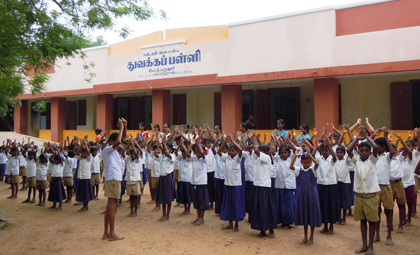
Mettumarudur Primary School

SEVAI strappingly believes that Education is important not only for the full development of one’s personality, but also for the sustained growth of the family. “The health, education and creative abilities of children will determine the well being and strength of a nation.

Pupils with dignity /giving full expression/ creativity in Primary schools

SEVAI team ensures quality of Education in SEVAI run primary schools and SEVAI team also works with the Government schools providing quality of education especially and for the Disadvantaged sections of the SEVAI target area particularly girls, Dalits, marginalized and (disabled), the differently abled.

SEVAI includes several features that seek to improve the quality of elementary education, ensuring basic provisioning to enable improvement in the quality of classroom transactions; (b) large scale capacity building of States, for undertaking interventions for quality enhancement; and (c) evaluation of quality related processes and assessment of learning outcomes. The expert group is to advise School teachers for the conduct of achievement study and to develop a Systemic Quality Index that helps SEVAI to interpret the result oriented outcomes of achievements.

SEVAI’s QUALITY MONITORING TOOLS – A continuous and comprehensive monitoring and supervision system has been developed by SEVAI in the form of quality monitoring tools are:(a)Children’s Attendance,(b) Community Support and Participation,(c)Teacher and Teacher Preparation,(d) Curriculum and Teaching Leaning Material,(e)Classroom Practices and Processes,(f) Learners’ Assessment, Monitoring and Supervision. The primary education provided in SEVAI is vertical in Development Gateway as an attempt to empower the children and teachers by providing ample resource materials to archive the goal of Elementary Education.SEVAI manages two Primary schools in Tamil medium in Mettu Marudur, in a a rural area and Bickchandar Koil,in an urban slum area.

Bichandar Koil Primary School with active learning with teaching aids.

  • Around for around 500 Pupils pursue their studies in these two schools run by SEVAI. In recent past, SEVAI has made a huge progress in terms of increasing primary education enrolment, retention, regular attendance rate in these two schools, the quality of elementary education, especially adopting Activity Based Learning methods.
  • In these SEVAI run schools, Primary Education includes the participatory ‘bottom up’ approach with transparency, and sustained monitoring school with the goal of educating all children as the best citizens of the Under this ABL method it is observed in SEVAI that these two schools where SEVAI actively involves that the Children learn on their own pace.
  • Provision of more time for self-directed learning and teacher directed learning is reduced considerably Group learning, mutual learning and self learning are promoted Teachers teaching time is judiciously distributed among children.
  • Only needy children are addressed by teachers Children’s participation in every step is ensured in the process of learning, Evaluation is inbuilt in the system it is done without the child knowing it.
  • In these two SEVAI run schools, it is observed that Reading and writing are individual activities, unless one is reading aloud for others to hear. Reading involves comprehending words. Reading also demands listening to what the writer wishes to communicate. Understanding means gathering relevant details and getting a sense of what one has read. Alertness and attentiveness demand that one understands whatever one is listening to, or reading, is another’s viewpoint. SEVAI teachers are intelligent and they are: open to lifelong learning, not just already learnt knowledge/ skills – not be tied to one way of looking at things, open to alternative solutions, willing to study, read, look at new seemingly unconnected information – capable of collaborative functioning – find the inner resources to listen to many views and respond – by seeking clarification, By rephrasing – by finding / articulating non-divisive questions for common engagement.

SEVAI Schools engage the primary school pupils intelligently in the knowledge age.

  • Able to see that all knowledge is limited
  • Be resourceful in and with the given context
  • Learn the other skills needed to make knowledge relevant
  • Be open to finding out the basic assumptions in what is being said, written, shown – ask questions, clarify
  • Feel free to ask if a view is factual and true, and under what circumstances

Enriching English language at the primary level :

English occupies a unique position in popular imagination. It is seen as a gateway to knowledge and is said to confer prestige and social distinction to anyone who learns to use it fluently. To enable all children to gain the advantages of this social phenomenon, it has been introduced conversational English in Class I itself in all these schools. In ABL methodology, English is introduced in Class I through conversation cards. However, learning to speak a second language involves some challenges. When children learn to speak their mother tongue, all their senses are actively engaged in the process. Learning to speak a second language in school does not replicate these natural processes and multi-sensory engagement.

Therefore, introduction of audio-visual technology in combination with print materials has been used to open out a host of opportunities for children to experience English in meaningful contexts. An audiovisual CD “Hello English” developed by Regional Institute of English was given to selected schools and children were exposed to it. Children watched the CD and then did activities suggested on it. Teachers and students were delighted with their programmes and they have begun to speak English without any psychological barrier.

Thanks for SSA for its innovative materials for Mathematics for classes’ I-IV have been enriched by the introduction of three-dimensional materials based on Montessori system.

There are 25 items such as Number Rods, Addition boards, Multiplication Cloth etc which concretize the basic arithmetic operations. Mid-day Meal Scheme involves provision of lunch free of cost to school-children on all working days.

The key objectives of the programme are: protecting children from classroom hunger, increasing school enrolment and attendance, improved socialisation among children, addressing malnutrition, and social empowerment through provision of employment to women. The success of this scheme is illustrated by the tremendous increase in the school participation and completion . The meals provided in SEVAI schools with Government support has Nutrition (also called nourishment) is the provision, to cells and organisms, of the materials to support life. Many common health problems are e prevented with this healthy diet.The diet of an organism is what it eats, and is largely determined by the perceived palatability of foods.

Details of associated services provided:

  • Supply of Nutritious Noon Meal
  • Supply of Free Slates for Standard 1.
  • Supply of Free Bus Pass for all students coming over to school.
  • Supply of Free Text Books for all students from Standard 1 to 5
  • Bridge course Non-formal Education for dropouts.
  • Open Schools those who completed 8th Standard.

2.SEVAI SHANTHI MATRICULATION HIGHER SECONDARY SCHOOL:

School pupils with full of freedom of self expression of creative thoughts……

The initiation of Shanthi School in Pettavaithalai has created great willingness and response among the villagers nearby towards sending their children to the School for getting education. The teachers promote the Children in the School with special attention in creative Education system. This integral formula multiple our aptitudes, adds our enthusiasm, subtracts our negligence, divides us from superiority complex.. Special Features of Creative Education System: The beginning of everyday is a smiling one for the children of Shanthi School, for school going. Around 1000 children hailing from the inerior rural villages are benefited by this school.

Group work and study also encouraged the children for the better quality of education. Specialized teachers imparts quality education focusing in-depth parts of the subjects and I methodology.

MORNING SCHOOL ASSEMBLY

The way of teaching and the other activities are designed for the new millenium children and the quality of the education has been updated every year towards periodic development. We are glad to inform you that this School has been recognized by the Government for conducting further 11th standard for the children to continue their higher studies. The students of Shanthi School achieved 100% result with first class marks in the Matriculation exam recognized by the Government. SEVAI Shanthi Matriculation Higher Secondary School is a unique educational institution in Trichirapalli District. It nurtures, in the minds of young children, all the values necessary for a successful and meaningful life. The aim of this humble institution is the accomplishment of the overall development of each child irrespective of its caste, creed or religion. SEVAI with the support of several well wishers and supporters founded this school, and it aims at providing quality education based on sound educational principles.

SEVAI undertakes Comprehensive developmental activities and as a part of its activities it had SEVAI Shanthi Matriculation Secondary School to provide quality education based on sound educational principles.

This SEVAI Shanthi Matriculation School achieved high quality of education and also human values and it has 100% pass every year with outstanding marks obtained in the Public Examination, Xth Standard. Our strong strength, our staff team are here dedicatedly working hard for the development of each and every student. This school has been elevated as higher secondary school from the year 2010, the strength increased to 1200 students and 43 staff members.

SEVAI Shanthi Higher Secondary School Courses: XI & XII Standard

  • Maths, Physics, Chemistry, Biology,
  • Maths, Physics, Chemistry, Computer Science, Accountancy,
  • Commerce, Economics, Computer Science

PARENTS’ TEACHERS MEET IN SCHOOL PREMISES

To that end this school is ecumenical in intention, international in perspective, caring in spirit, committed in action and dedicated to excellence as such,

  • The school reinforces the philosophy, mission and objectives of ” SEVAI Shanthi Matriculation Higher Secondary School “,
  • Promotes Academic excellence,
  • Enables each student to reach his or her potential in all dimensions.
  • The purpose of the higher sec. school Uniform Policy is to provide a regular appearance, and to assure adequate protection from the climate, consistent with school activity.
  • The uniform policy promotes the development of good personal grooming habits. The wearing of the school uniform is obligatory. All items should be marked with the student’s name.
  • Infrastructure Lab/Lib./computer facilities/eco-clubs
  • SEVAI Shanthi Matriculation Higher Secondary School is also a caring environment where students are encouraged to reach their full potential, prepared to think globally, with a commitment to justice and challenged to act responsibly in a consistently changing society.
  • SEVAI Shanthi Matriculation Higher Secondary School with a consistent track record for achieving the highest academic results.SEVAI Shanthi Matriculation Higher Secondary School has a comprehensive curriculum that is varied to cater for all students’ needs.
  • SEVAI Shanthi Matriculation Higher Secondary School has invested over the past 5 years in developing our campus, with the objective of giving our students the very best environment and facilities to work in. SEVAI Shanthi Matriculation Higher Secondary School has Visual and Performing Arts program and facility which is probably the best in Trichy today.
  • SEVAI Shanthi Matriculation Higher Secondary School Athletics program is regarded by many as one of the most comprehensive of any of the matriculation schools in Tamil Nadu and one that has seen significant success over the years.
  • SEVAI Shanthi Matriculation Higher Secondary School is also a caring environment where students are encouraged to reach their full potential, prepared to think globally, with a commitment to justice and challenged to act responsibly in a consistently changing society.
  • SEVAI Shanthi Matriculation Higher Secondary School with a consistent track record for achieving the highest academic results.SEVAI Shanthi Matriculation Higher Secondary School has a comprehensive curriculum that is varied to cater for all students’ needs.
  • SEVAI Shanthi Matriculation Higher Secondary School has invested over the past 5 years in developing our campus, with the objective of giving our students the very best environment and facilities to work in. SEVAI Shanthi Matriculation Higher Secondary School has Visual and Performing Arts program and facility which is probably the best in Trichy today.
  • SEVAI Shanthi Matriculation Higher Secondary School Athletics program is regarded by many as one of the most comprehensive of any of the matriculation schools in Tamil Nadu and one that has seen significant success over the years.

School Building

  • SEVAI Shanthi Matriculation Higher Secondary School provides plenty of opportunities for the all-around development of our pupils. This is done through various literary & cultural associations of our school. Activities like Scouts & Guides, Road Safety Patrol, Bull Bulls, Band, Cubs Sports activities, Dance, Music classes are conducted regularly.
  • SEVAI Shanthi Matriculation Higher Secondary School has Scouts & Guides troops to cultivate the habit of becoming good citizens and to improve the humanity of the country. It conducts a regular camp which helps to face the abnormal situation without the help of others. In camps various games are conducted which improves the physical & mental abilities of the children. It has been carried out by well trained teachers.
  • SEVAI Shanthi Matriculation Higher Secondary School has Road Safety Patrol troops.
  • Every day a group of students perform some functions outside the school campus. It helps the students to realize the disaster of the accidents and how they can prevent it.
  • First aids are taught to these students so that they can save many lives.
  • SEVAI Shanthi Matriculation Higher Secondary School yoga classes twice a week. It strengthens the mental ability of the children.
  • “True glory consists in doing and living to make the world happier and better for our living in it.”
  • Under the guidance of 2 teachers, 40 students take active role in awakening environmental awareness among people.
  • SEVAI School Pupils behave in a courteous and gentle manner on all occasions.
    • They address their teachers and all members of the staff with due respect and politeness. Good moral behavior and gentle ways are prerequisites of every student.
    • They always remember that the school is judged by their conduct. All Students strictly observe the rules of the school, attending of home work, regular attendance, moral behavior, disobedience, and respect towards the members of the staff.
    • Parents’ takes part and co-operate in the work of the school by enforcing regularity, punctuality and discipline and by taking a daily interest in their children’s progress.
    • They check the diary daily for any remarks and note the homework given. The parents also check the diaries regularly and note the teachers’ remark, etc., and acknowledge the same promptly by placing their signature against the remark.
    • Parents also see that their children study and do their homework regularly. Parents make their own arrangement whenever students are asked to come before / remain after school hours for various curricular and extra curricular activities. Whenever the parents are asked to meet the principal to discuss their son’s academic condition / any misbehavior, they meet the Principal without fail on the stipulated date specified in the circular letter sent by the school office.
    • Parents who seek information or who wish to make some complaint should do so to the Principal and not to the class teacher.
    • Parents, guardians or other persons are not allowed to meet the students or interview their teachers during school hours without permission of the Principal.
    • The members of the staff be met during their free periods or school recesses.

    School Teachers Welcome the Parents and Guests

    • Parents, when communicating with the principal, are requested to mention in their letter the class (standard) and division of their children.
    • Parents who wish to take their children out during the school hours should get the necessary written permission from the Principal by submitting a letter and stating the reason.
    • Parents should come in persons to take their children from the school
    • Normally school is a place where children are taught. The process of teaching differs from school to school depending on the ideals and philosophy of the schools.
    • A school that has futuristic approach knows the difference between teaching for marks and teaching for life.
    • SEVAI School has a judicious mixture of these both ingredients of education. A student of such a school has exciting experience of gathering more and more skills for his life.

    In SEVAI SHANTHI MATRICULATION HIGHER SECONDARY SCHOOL

    Students are exposed to the four basic skills for the success of life.

    1. Skill to take decisions in a short time,
    2. Skill to accept difficult situations,
    3. Skill to communicate what he has in mind to others effectively,
    4. Skill to work under pressure.

    SEVAI still keep their minds clear about the goal of education i.e to prepare the students entrusted to them to face the world boldly with justice, equality, liberty and fraternity. A school, which prepares their students only for the board examination will never achieve this end.

    3. SEVAI Vocational Education and Training (SVET).

    SEVAI Vocational education or Vocational Education and Training (VET)prepares Target area women and youth learners for jobs that are based in manual or practical activities, traditionally non-academic and totally related to a specific trade,

    The SEVAI vocational Educational Institute focuses on need based training on the basis on which young people acquire the skills needed for long-term employment, and provides people with the skills that the economy requires. SEVAI Vocational Educational Institute enhanced the following areas:

    1. Impact vocational skills, life skills and technical knowledge to neo-literates and their trainees and raise their efficiency and increase their productive ability;
    2. Organize equivalency programmes for its beneficiaries through Open Schools;
    3. Through Life Enrichment Education (LEE), wide the knowledge and understanding of the social, economic and political systems among its beneficiaries in order to create a critical awareness about the environment;
    4. Promote national goals such as secularism, national integration, women’s equality, protection and conservation of the environment.
    5. SEVAI Vocational Educational Institute offers need based vocational training programmes from candle making to computer courses with assured placements.

      • As vocational Education is both the means as well as the end to a better life: means, because it empowers an individual to earn his/her livelihood with employability skill, it increases one’s awareness on a range of issues –appropriate social behavior to understanding one’s rights – and in the process evolve as a better citizen. Vocational training in SEVAI is provided on a full time as well as part time basis.
      • Continuous, career-long learning provided in SEVAI Vocational Educational Institute new procedures and methods for occupational education.
      • The area of “media and methods” develops strategies to promote selforganised in SEVAI Vocational Educational Institute learning, analyses procedures and methods of workplace learning, in particular the potential for development, and other modes of learning.
      • It also investigates the ways in which informally acquired skills can be certified, including from the perspective of the Internationalization of vocational training.
      • SEVAI has promoted an Institute for Continuing Education as Life long learning on the concept ‚’Fit for Job and Fit for Life’ as Continued and Lifelong learning has become a necessity in today’s dynamic information society.
      • Sevai Institute for Continuing Education has been approved by Universities as their learning centres for persusing job oriented courses and this means that new occupational training structures and new learning methods are developed for both classroom and week-end -classroom settings.
      • A variety of courses open to the target area of SEVAI are offered throughout the year by Continuing Education. Courses are held on Allur and Nagapatinam, Karaikal campuses. Courses are offered not only at working days but also during week ends. SEVAI programs are designed to provide the skills necessary to acquire professional level positions for many in-demand occupations.
      • SEVAI currently offers certificate programs in the areas of addressing the following community needs: Self-Enrichment, Vocational, and Lifelong Learning: Art, Health, Agriculture and Non-farm Activities and Special Interest, Healthcare and Fitness, Helpers of the Hospitals and Nursing Homes, Early Childhood Education, Enterprise Management, Management of Firms and accountancy, Self Help Groups Managements,Bio farming and horticulture, Skilled Trades.
      • SEVAI understnands that the need for learning is on the rise, but diagnosing the nature and scope of this need is becoming increasingly difficult. Although it is sometimes said nowadays that each individual must take greater responsibility for their own employability, the task of ensuring that a society’s workforce has the necessary skills cannot be left to individual assessments or to natural development of an inherent learning culture.
      • Hence, SEVAI’s “continuing education” focuses on the upradation of continuing learning opportunities, particularly concerning the integration of learning into everyday work duties and processes, and the various stages of employees’ career paths.
      • SEVAI’s study in Trichy ubran areas reveals that many enterprises are seeking to pay more attention to the qualification and development of their staff – not least given the increasing shortage of suitable workers. SEVAI had identified that Small and medium-sized firms in particular require flexible approaches to qualifications, which take into account limited personnel, time and financial resources and allow firm-specific approaches. In Trichy alone 35000 jobs are available but they do not have employable youth. The unemployed youth are given training to be employable in SEVAI,Allur,Naapattinam and other potental locations.
      • SEVAI Institute for Continuing Education has understood well that Continuing Education plays an increasingly important role in the future for individuals, society and the economy and the importance of educational support by SEVAI lies in the contribution which it can make to the systematic orientation of continuing education.
      • SEVAI analyses processes, structures and institutions and University’s Efficiency at ways to shape Continuing education training in an efficient and effective way. Today, Continuing Education has emerged as an important source of employment.SEVAI has taken many significant initiatives to popularize continuing vocational education quality training.

    4. NON –FORMAL EDUCATION FOR SCHOOL DROP-OUTS:

    SEVAI implemented this project Non-formal Education Programme covers more underprivileged children from rural areas for 1500 children in early 2000. Classes IV and V have already been added in this project with proper teachers and extracurricular activities.

    Non-Formal vocational Education Institute for School Dropouts

    • Along with educational support, health care is integrated in the project. Regular health check-up and growth monitoring is ensured for the children. Keeping in mind the children’s nutritional need and support, all the children get balanced mid-day meal at the centre.
    • The special components of the project are that 50% of the children get NFE [Non-formal Education], who are either non–school going or school dropouts. Health checkup of all children enrolled and their growth is monitored.
    • Teachers maintain a homely environment with the students so that they will love coming to the school, Monitoring of the children once they are mainstreamed to formal schools, Regular health check-up, growth monitoring as well as nutritional support are ensured, SEVAI had vowed to make the integrated programme a showcase project for empowering the society by providing education to children from the underprivileged section.
    • SEVAI experienced that Learning is not restricted to the time spent in school. However, ongoing learning throughout life enables people to take advantage of new opportunities that arise as society changes.
    • It also provides opportunities for those who are unemployed to re-enter the workforce. Every kind of learning that happens outside the traditional school setting is called non-formal. However, SEVAI sees non-formal education as an educational movement, a setting, a process and a system. The projects and programmes implemented by SEVAI under the label of ‘non-formal education’ are very diverse in scope.
    • What usually has in common is an organised, systematic, educational activity, carried on outside the framework of the formal education system, to provide different types of learning to particular groups in the population, both adults and children. Thus non-formal education is different from the institutionalised, chronologically graded and hierarchically structured nature of the formal education system.
    • SEVAI views that Education is the power which can transform lives. Children born to underprivileged parents do not mean they can’t excel and we being elder just need to hold their hands a bit.We love our children and they love us. It is this bond between us that will ensure a bright future for these underprivileged children and a sense of purpose for SEVAI, without support from good hearts, it would have been impossible to grow and reach where we are today.

    Children Born to Underprivileged Can Also Excel and We to Hold Their Hands a Bit

    SEVAI incorporated a project component titled “Empowering Adolescents through Life Skills Education”. The project follows Life Skills Education strategy, which is a comprehensive behaviour change approach that concentrates on the development of the skills needed for life such as communication, decision making, thinking, managing emotions, assertiveness, resisting peer pressure etc.

    Categories
    OUR PROJECTS

    Shanti school

    Categories
    OUR PROJECTS

    WATERSHED

    Watershed Projects. Thottiyapatty/Dasilnaikanoor/Kakayampaty Making Running water Walk’

    Watershed Location Map

    SEVAI Founder, K.Govindaraju, started his mission with villagers’ interaction in interior villages, Lead a team of gradates and undertook a research study on Rural Cumulative Poverty in 412 villages in Tamilnadu in 1975 and a report was brought out on findings. A monograph had been brought out under the technical support of the Administrative Staff College; Hyderabad for assessing the cumulative poverty hit villages and selected poorest of the poor villages and initiated development intervention based on the study.

    Interaction With Community And Baseline Survey

    View of Thottiyapatty before Watershed / PRA Process

    The objectives of SEVAI are employment, environment, and enlightenment. The SEVAI believes that the village as a human settlement, a socio-economic entity, with an identity and history of its own, which has grown as a result of interaction with a particular eco system, should not only survive in modern society, but also should grow in strength. ‘Watershed development has been conceived basically as a strategy for protecting the livelihoods of the people inhabiting the fragile ecosystems experiencing soil erosion and moisture stress”. Man and his environment are interdependent.

    The changes in the environment directly affect the lives of the people depending on it. A degraded environment means a degraded quality of life of the people. Environmental degradation can be tackled effectively through the holistic development of the watershed. A watershed provides a natural geo- hydrological unit for planning any developmental initiative.

    Watershed development and management implies an integration of technologies within the natural boundary of a drainage area for optimum development of land, water and plant resources, to meet the people’s basic needs in a sustained manner.

    This watershed is an area from which runoff resulting from precipitation flows past a single point into a large stream, river, lake/ pond. Each watershed is an independent hydrological unit. It has become an acceptable unit of planning for optimum use and conservation of soil and water resources.

    The concept of integrated watershed development refers to the development and management of the resources in the watershed to achieve higher sustainable production without deterioration in the resource base and any ecological imbalances.

    This concept requires the formulation and implementation of a package of programmes with activities for optimum resource use in the watershed without adversely affecting the soil and water base or life supporting system.

    The concept assumes more importance in the context of planning for sustained development.

    Watershed development aims at preventing watershed degradation resulting from the interaction of physiographic features. It eliminates unscientific land use, inappropriate cropping patterns and soil erosion, thereby improving and sustaining productivity of resources leading to higher income and living standards for the inhabitants in the watershed area.

    It therefore involves restoration of the ecosystem, protecting and utilizing the locally available resources within a watershed to achieve sustainable development.

    Rainfall failure occurs once every 3 to 5 years and is usually below 50% of the average annual rainfall of the region. During periods of rainfall failure, the groundwater level lowers since fluctuations in the water table levels depend on the rainfall when both surface and groundwater availability becomes critical.

    Drought begins to prevail and there is difficult to cope up with the water demand during this period. Similarly, in some locations or areas water shortage is observed just before the rainy season commences. These two situations can be managed if suitable soil and moisture conservation measures are systematically implemented on a small watershed basis. • There are always strong links between soil conservation and water conservation measures. Many actions are directed primarily to one or the other, but most contain an element of both. Reduction of surface runoff can be achieved by constructing suitable structures or by changes in land management.

    Further, this reduction of surface runoff will increase infiltration and help in water conservation. Water/soil conservation process.

    Watershed is defined as a geohydrological unit draining to a common point by a system of drains. All lands on earth are part of one watershed or other. Watershed is thus the land and water area, which contributes runoff to a common point. Water is essential for all life and is used in many different ways – for food production, drinking and domestic uses. It is also part of the larger ecosystem on which bio diversity depends.

    • Precipitation, converted to soil and groundwater and thus accessible to vegetation and people, is the dominant pre-condition for biomass production and social development in dry lands.
    • The amount of available water is equivalent to the water moving through the landscape. It also fluctuates between the wet and dry periods.
    • Irrigation potential which exists in Tamilnadu is much more than the presently irrigated area for food security.
    • A variety of essential soil moisture and water conservation technologies adopted to reduce the cost of irrigation, extend it throughout and promote sustainable small-scale irrigation on a watershed basis in the PVF supported watersheds will be documented.
    • Watershed technologies are essential especially in drought-prone areas. Even though drought is a purely natural calamity caused by the failure of (monsoon) rain, it can be minimized by careful planning and operation.
    • During good rainy years, excess rainwater should be stored in the soil and also underground using suitable soil moisture conservation measures and water harvesting structures on a watershed basis. This stored water can subsequently be used for irrigation.

    The word watershed refers to a “contiguous area draining into a single water body or a water course” or “it is a topographical area having a common drainage”. This means that the rainwater falling on an area coming within a ridgeline can be harvested and will flow out of this area thorough single point. The term watershed development encompasses additional dimensions like equity, sustainability, gender and peoples participation. It has become a trusted tool for the overall development of the village and people living within a watershed area.

    Objectives of watershed management implemented in SEVAI in Dasilnaickanoor/Thottiyapatty/Kakayampatty cluster.

    The different objectives of watershed management programmes achieved are:

    1. To control damaging runoff and degradation and thereby conservation of soil and water.
    2. To manage and utilize the runoff water for useful purpose.
    3. To protect, conserve and improve the land of watershed for more efficient and sustained production.
    4. To protect and enhance the water resource originating in the watershed.
    5. To check soil erosion and to reduce the effect of sediment yield on the watershed.
    6. To rehabilitate the deteriorating lands.
    7. To moderate the floods peaks at down stream areas.
    8. To increase infiltration of rainwater.
    9. To improve and increase the production of timbers, fodder and wild life resource.
    10. To enhance the ground water recharge, wherever applicable
    • Actualize the vast untapped growth potential of Indian agriculture
    • Strengthened rural infrastructure to support faster agricultural development
    • Promoted value addition, accelerate the growth of agro enterprises among self help groups
    • Created employment in rural areas
    • Secured a fair standard of living for all agriculturalists and SHGs
    • Discouraged migration to urban areas and face the challenges arising out of economic liberalization and globalisation.
    • Resource mobilisation for sustainablity such as soil, farm equipment, loans and packages of practice of different crops.
    • Improvement of the Quality soil is one of the most important farming inputs.
    • High yields and good produce can be achieved only when the right type of soil is used for a certain crop.
    • Agriculturalists / individual entrepreneurs -setting up of small dairy farms for milk production.
    • Popularization of new technologies/tools/techniques for commercialization/ adoption.
    • Introduction of new concepts to improve farming systems.
    • Upgradation of skills by exchange of technical know-how.
    • Development of agriculture and allied sectors by better farming practices and cropping patterns, judicious use of water by introducing drip irrigation system, yield enhancement etc. as a result the village where nearly three- fourth population was below poverty line, has become self sufficient and is surplus in food grains, today.
    • Development of managerial skills and capability among people with low level of education, exposure and training.
    • Enough scope for women for self development.
    • An appreciable change in the attitude of the people with high degree of moral standards and ethics.
    • Over all improvement in the quality of life of the people, and conservation and use of the natural resources in a very sustainable manner.

    The broad range of initial community mobilization and organization activities is as follows:

    • Conducting formal and informal meeting among the watershed community
    • Conducting awareness campaign through audio visual aids and folk songs and theatre
    • Preparation of audio visual aids for the awareness campaigns
    • Conducting Benchmark and Socio-economic Surveys to obtain baseline data
    • Conducting Participatory Rural Appraisals (PRAs) in all three selected watersheds
    • Capacity Building activities imparting training in technical, managerial, financial areas
    • Formation of Watershed Association and Committees
    • Formation of User Groups
    • Facilitation for preparation of participatory Perspective Watershed Development Plan
    • Conducting managerial and technical training to the established local level institutions
    • Formation and development of Self Help Groups
    • Conducting Participatory Evaluation based on established Performance Indicators
    • Facilitating post-project management and sustainable project activities.
    • Training in community mobilization and agriculture

    Watershed management practices

    1. Interms of purpose
    2. To increase infiltration
    3. To increase water holding capacity
    4. To prevent soil erosion
    5. Method and accomplishment
      1. Increasing House Hold Income
      2. Improving Agriculture Productivity.
      3. Improving Vegetative Cover.
      4. Increasing Milk and Horticulture Production.
      5. Increasing Fodder and Fuel availability.
      6. Reducing Soil Erosion & Runoff to Improve Water Availability.
      7. Enhancing Quality and Life of Village Communities.
      8. Use of land, water and vegetation according to its capability we can changes in knowledge, skills, attitudes for enhancing resource use efficiency and improvement in socio-economic and ecological conditions

    In brief various control measures undertaken by SEVAI are:

    1. Vegetative measures & Strip cropping
    2. Pasture cropping
    3. Grass land farming
    4. Wood lands
    5. Engineering measures
    6. Contour bunding
    7. Terracing
    8. Construction of earthen embankment
    9. Construction of check dams
    10. Construction of farm ponds
    11. Construction of diversion
    12. Gully controlling structure
    13. Rock dam
    14. Establishment of permanent grass and vegetation
    15. Providing vegetative and stone barriers
    16. Construction of silt tanks dentension Influence of soil conservation measures and vegetation cover on erosion, Runoff and Nutrient loss.
    17. Rainwater harvesting is the main component of watershed management.

    SEVAI has completed the following RWH projects in three watersheds:

    • 12 check dams
    • 21 percolation tanks
    • 118 farm ponds
    • 218 gullies repaired
    • 15 underground tanks.

    Watershed impact of three watersheds:

    • Actualize the vast untapped growth potential of Indian agriculture
    • Strengthened rural infrastructure to support faster agricultural development
    • Promoted value addition, accelerate the growth of agro enterprises among self help groups
    • Created employment in rural areas
    • Secured a fair standard of living for all agriculturalists and SHGs
    • Discouraged migration to urban areas and face the challenges arising out of economic liberalization and globalisation.
    • Resource mobilisation for sustainablity such as soil, farm equipment, loans and packages of practice of different crops.
    • Improvement of the Quality soil is one of the most important farming inputs. High yields and good produce can be achieved only when the right type of soil is used for a certain crop.
    • Agriculturalists / individual entrepreneurs -setting up of small dairy farms for milk production.
    • Popularization of new technologies/tools/techniques for commercialization/ adoption.
    • Introduction of new concepts to improve farming systems.
    • Upgradation of skills by exchange of technical know-how.
    • Development of agriculture and allied sectors by better farming practices and cropping patterns, judicious use of water by introducing drip irrigation system, yield enhancement etc. as a result the village where nearly three- fourth population was below poverty line, has become self sufficient and is surplus in food grains, today.
    • Development of managerial skills and capability among people with low level of education, exposure and training.
    • Enough scope for women for self development.
    • An appreciable change in the attitude of the people with high degree of moral standards and ethics.

    Improved Economy with Gender Perspective

    • Rain Water Harvesting through open wells, development of small water harvesting structures as low – cost farm ponds, nullah bunds, check dams, percolation tanks.
    • The impact of such activities is a reduction in runoff rain water in open fields, increase in water level, increase in area under cultivation and curbing of top soil erosion.
    • Renovation and de-silting of tanks / ponds, augmentation of water sources. This has resulted in filling irrigation gap, increase in water storage capacity, dry land cultivation being brought under wet land cultivation, conversion from single crop area to double crop area, increase in water in nearby wells and in tank itself (2-3 times) Social forestry and orchard plantations. While afforestration has lead to increase in green cover and improvement in the ecosystem, the planting of orchards has brought more wastelands under plantation with an increase in intercrop area.
    • The most significant advantage is the appreciation of land value under herbal cultivation. Land development and reclamation including in-situ soil and moisture conservation measures. Principally activities undertaken include reclamation of degraded and undulated wastelands to level land through land leveling thereby brought under cultivation with earthen bunding on sides.
    • This has controlled soil erosion, lead to increase in moisture retention capacity, increased wasteland brought under cultivation, conversion of dry land to wet land, increase in production and subsequent increase in land value indicating increase in income. Minor / Major / diversion check dams and stone bunding structures.
    • These minor civil structures mode of locally available materials helps in arresting top soil erosion as they are laid in slopes with over 10 percent gradient. As a result of such measures, there is increase in moisture retention in catchments areas, increase in production, conversion of wasteland into cultivable land and additional vegetative cover.

    Executive Summary of the watershed Thottiyapatty/Dasilnaickanoor and Kakayampatty.

    • A watershed 412 ha in three micro watersheds 25 km south of Kulitalai in Manaparai Road, in Karur District, Tamilnadu.

    Problem

  • Low erratic rainfall averaging 700 mm per year, and recurrent droughts;
  • Soil erosion resulting in a reduction of cultivable land and the abandonment of severely eroded areas;
  • Infertile sandy soils with very low water retention and storage capacity;
  • Reduction in plot sizes due to land allocations to the homeless, population growth and inheritance laws;
  • Low crop yields and frequent failure due to drought;
  • Degraded communal grazing land due to overstocking;
  • Lowered water table because of over-exploitation;
  • Acute scarcity of fodder and fuelwood;
  • Seasonal migration of human and livestock populations;
  • Change from mix cropping to single crop system.
  • Intervention

    • Introducing the management of natural resources – soil, water, vegetation and animals for increased production through an integrated sustainable production system over the whole watershed;
    • Field testing of nationally developed dryland farming technologies;
    • Increasing awareness among rural people to encourage participation in the new system.

    Achievements

    • Land protection using multi- purpose shelter belts against wind and water erosion;
    • Reclamation of 120 ha of wasteland through gully stopping;
    • Improved and sustainable source of fuel wood from shelterbelt pruning;
    • Increased yields from intercropping drought-tolerant high yielding crops with fast- growing, multi-purpose trees;
    • Increased acreages (3-4 times) of irrigated commercial crops and double cropping because of improved water harvesting;
    • Improved dairy output resultant on increased fodder availability;
    • Higher incomes through produce, sales and employment opportunities – poverty alleviation;
    • Improved housing, access to education, nutrition and health.;
    • Improved vegetation cover and biodiversity. overall achievements
    • A rise in groundwater level;
    • Recognition of the value of the integrated management of natural resources widely recognized by government ministries with the consequent policy that dry land areas be based on watershed-based integrated management.;